
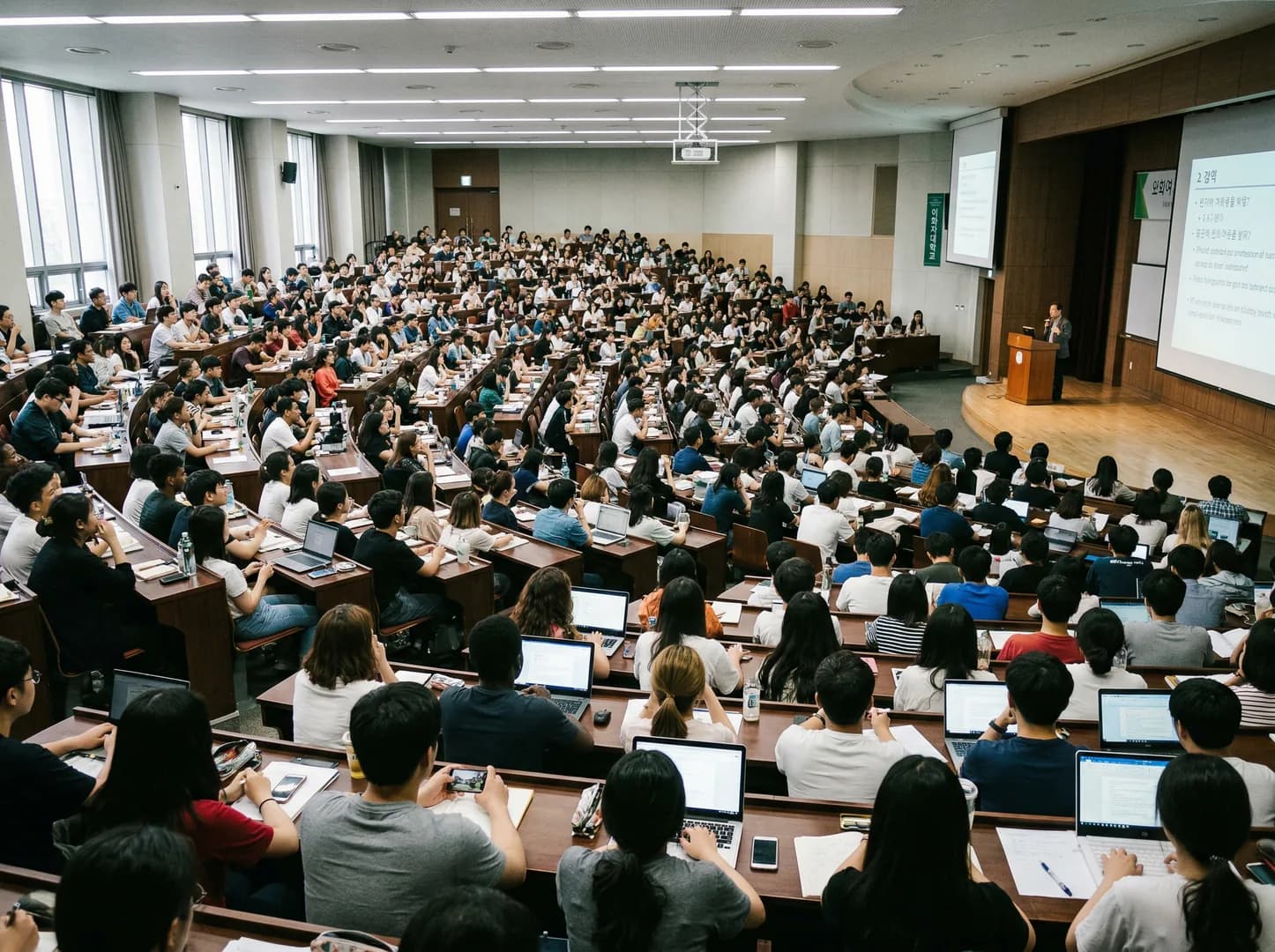
International Student Status
The number of international students in Korea has been steadily increasing. As of 2024, it exceeded 210,000, reaching an all-time high. K-culture, the global status of Korean companies, and excellent educational infrastructure are the main factors.
Yearly Student Trends
| Year | Total | Degree Programs | Language Training |
|---|---|---|---|
| 2019 | 160,165 | 100,215 | 59,950 |
| 2020 | 153,695 | 113,003 | 40,692 |
| 2021 | 152,281 | 120,018 | 32,263 |
| 2022 | 166,892 | 131,049 | 35,843 |
| 2023 | 181,842 | 141,610 | 40,232 |
| 2024 | 211,026 | 165,866 | 45,160 |
Trend Analysis
- 2020-2021: Temporary decline due to COVID-19
- From 2022 onward: recovery turned into a sharp increase
- Rising share of degree programs: a shift from language courses to degree programs
- K-culture impact: growing popularity of Korean content driving a surge in Korean-language learning demand
By Degree Level (2024)
| Program | Students | Ratio |
|---|---|---|
| Associate | 15,233 | 9.2% |
| Bachelor's | 108,547 | 65.4% |
| Master's | 29,869 | 18.0% |
| Doctorate | 12,217 | 7.4% |
* Degree programs include bachelor's, master's, and doctoral courses
Students by Nationality
International students come from diverse countries, with the largest numbers from Asian countries including China, Vietnam, and Mongolia.
Top 10 Countries (2024)
| Rank | Country | Students | Ratio |
|---|---|---|---|
| 1 | China | 72,459 | 34.3% |
| 2 | Vietnam | 57,361 | 27.2% |
| 3 | Uzbekistan | 17,543 | 8.3% |
| 4 | Mongolia | 9,127 | 4.3% |
| 5 | Japan | 5,891 | 2.8% |
| 6 | Nepal | 5,234 | 2.5% |
| 7 | USA | 4,521 | 2.1% |
| 8 | Indonesia | 4,118 | 2.0% |
| 9 | Taiwan | 3,456 | 1.6% |
| 10 | India | 2,987 | 1.4% |
Growth Trends by Nationality
- Uzbekistan: More than tripled over the past 5 years
- Mongolia: Steady growth driven by the popularity of Korean culture
- Nepal: Rising study-abroad numbers driven by employment goals
- Indonesia: Surging due to the influence of K-pop and K-dramas
Country-Specific Insights
- Chinese students mainly focus on business and Korean language programs
- Vietnamese students prefer IT and engineering fields
- Uzbek students show interest in trade and manufacturing sectors
- Mongolian students often choose healthcare and education majors
Regional Distribution
International students are distributed across Korea, with the highest concentration in Seoul and the metropolitan area.
Distribution by Province (2024)
| Region | Students | Ratio |
|---|---|---|
| Seoul | 78,432 | 37.2% |
| Gyeonggi | 32,156 | 15.2% |
| Busan | 14,823 | 7.0% |
| Daejeon/Chungcheong | 21,345 | 10.1% |
| Daegu/Gyeongbuk | 18,567 | 8.8% |
| Gwangju/Jeolla | 12,234 | 5.8% |
| Incheon | 11,892 | 5.6% |
| Other | 21,577 | 10.2% |
Regional Features
- Seoul: Concentration of top universities, abundant job opportunities, high cost of living (rent ₩500K-800K/month)
- Gyeonggi: Good access to Seoul, relatively affordable, many emerging universities
- Busan: Strength in maritime/tourism fields, 30% cheaper cost of living than Seoul
- Daejeon/Chungcheong: Specialized in science and technology (KAIST, Chungnam National University, etc.)
- Daegu/Gyeongbuk: Strength in textiles/fashion and healthcare fields
- Gwangju/Jeolla: Culture and arts, agriculture, many scholarship benefits
Tuition Fees
Tuition fees vary significantly by university type and major. National universities generally offer lower tuition than private universities.
Average Annual Tuition (2024)
| Type | Humanities/Social | Natural Sciences | Engineering | Arts/Physical Ed. |
|---|---|---|---|---|
| National/Public | ₩4.1M | ₩5.1M | ₩5.3M | ₩5.5M |
| Private | ₩6.8M | ₩8.1M | ₩8.4M | ₩8.9M |
Tuition Comparison
- Korea: About ₩4M-9M (approx. $3,000-$7,000)
- United States: About $20,000-$50,000 (state university basis)
- United Kingdom: About £9,250-£40,000
- Australia: About AUD 20,000-45,000
- Japan: About ¥500,000-1,500,000
Actual Tuition Burden
With a scholarship, your actual burden is greatly reduced. On average, students receive a 30-50% reduction, and top performers can even receive a 100% full scholarship.
Example: Private university humanities tuition 6.8 million KRW → TOPIK Level 5 scholarship 50% = actual payment 3.4 million KRW/year
Employment Rate
Korea offers various employment opportunities for international graduates, with an increasing number staying to work after graduation.
Post-Graduation Employment Status
| Item | Value |
|---|---|
| Korea stay rate after graduation | About 35% |
| E-7 work visa conversion rate | About 18% |
| D-10 (job-seeking visa) application rate | About 25% |
| Average job search duration | About 4-8 months |
| Major employment fields | IT, Trade, Tourism, Manufacturing |
Industry Breakdown
- IT/Software development: 32%
- Trade/Marketing: 24%
- Manufacturing: 18%
- Translation/Interpretation & Education: 12%
- Tourism/Services: 8%
- Other: 6%
Salary Range
- Large companies: ₩40M-55M
- Mid-sized companies: ₩32M-40M
- Small and medium enterprises (SMEs): ₩28M-35M
- Startups: ₩30M-45M (performance bonus separate)
Favorable Conditions for Employment
- TOPIK Level 5 or higher (large companies prefer Level 6)
- STEM majors (IT, engineering, data science, etc.)
- Domestic internship experience (3+ months)
- Relevant certifications (national technical qualifications preferred)
- Master's degree or higher from a Korean university
TOPIK Test Statistics
TOPIK (Test of Proficiency in Korean) is essential for university admission, scholarship applications, and employment in Korea.
Yearly Test Takers
| Year | Domestic | Overseas | Total |
|---|---|---|---|
| 2020 | 98,765 | 187,432 | 286,197 |
| 2021 | 112,543 | 203,876 | 316,419 |
| 2022 | 134,567 | 245,123 | 379,690 |
| 2023 | 156,789 | 289,456 | 446,245 |
Level Distribution Among Students
- Level 1: 8%
- Level 2: 15%
- Level 3: 22%
- Level 4: 26%
- Level 5: 18%
- Level 6: 11%
Pass Rate Information
- TOPIK I: Generally high pass rate (70%+)
- TOPIK II: More challenging, varies by target level
Top 5 Countries by Number of Test Takers
- 1st: China (approx. 35%)
- 2nd: Vietnam (approx. 18%)
- 3rd: Japan (approx. 12%)
- 4th: Indonesia (approx. 6%)
- 5th: Thailand (approx. 4%)
Study Satisfaction
International student satisfaction surveys show overall positive experiences, with room for improvement in some areas.
Overall Satisfaction
4.1/5.0
Based on comprehensive surveys of international students
Key Satisfaction Factors
| Factor | Rating |
|---|---|
| Safety | 4.5 / 5.0 |
| Transportation | 4.4 / 5.0 |
| Cultural Experience | 4.4 / 5.0 |
| Living Infrastructure | 4.3 / 5.0 |
| Education Quality | 4.2 / 5.0 |
| Korean-language learning environment | 4.1 / 5.0 |
| Employment linkage | 3.6 / 5.0 |
| Housing cost burden | 3.2 / 5.0 |
Key Strengths
- World-class public safety (safe even at night)
- Convenient public transportation (subway, bus network)
- Fast internet and advanced IT infrastructure
- Cultural experiences in the home of K-culture
- 24-hour convenience facilities (convenience stores, cafes, delivery)
- Affordable healthcare costs (with health insurance coverage)
Areas for Improvement
- Housing cost burden (especially in Seoul)
- Strengthening employment linkage programs
- Expanding administrative services for foreigners
- Expanding medical interpretation services
- Easing part-time work hour restrictions
Recommendation Rate
78%
78% of respondents said they would 'recommend studying in Korea to others'
Frequently Asked Questions (FAQ)
Q. Why is the number of international students increasing in Korea?
A. Key factors include K-culture popularity (K-pop, K-drama), relatively affordable tuition, safe living environment, and high-quality education. Rising global status of Korean companies also attracts career-focused students.
Q. Why is the employment rate for international graduates relatively low?
A. Main challenges include visa requirements (company size, job restrictions), business Korean communication skills, and unfamiliarity with Korean hiring processes. However, well-prepared students have much higher success rates.
Q. Which region should I study in?
A. Depends on your goals. For job opportunities, choose the Seoul area. For cost savings, regional cities. For specific fields (tech, marine sciences), choose specialized regions.
Q. Are scholarships difficult to get?
A. Competition varies, but most universities offer 30-50% tuition reduction. Your chances improve with high TOPIK scores, good grades, and applying to regional universities with less competition.
Q. Where does this statistics data come from?
A. From official government sources: Ministry of Education, KEDI (Korean Educational Development Institute), NIIED, and Study in Korea. Visit these websites for the latest updates.