
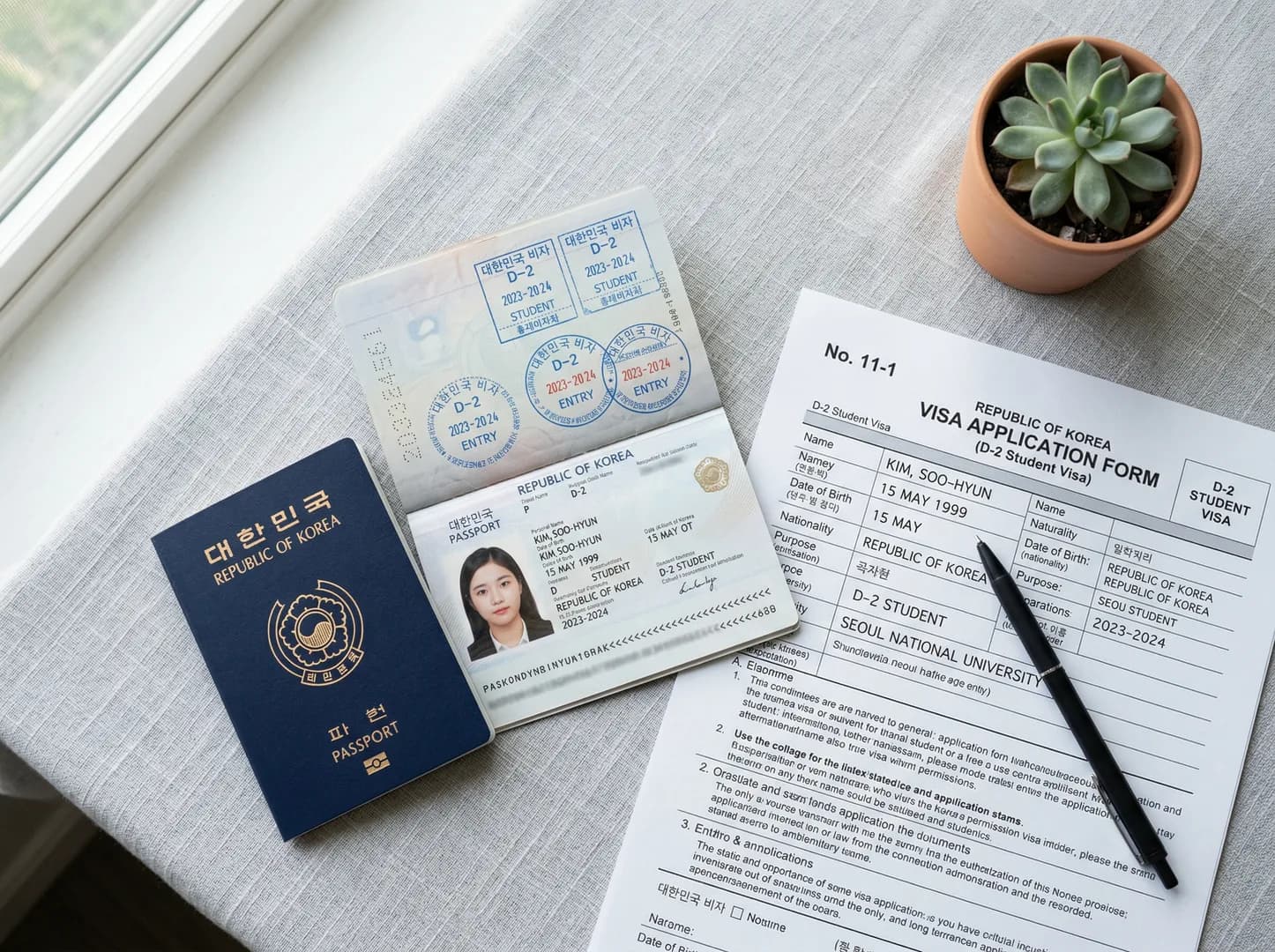
Student Visa Types
You need the appropriate visa to study in Korea. You should obtain either a D-2 or D-4 visa depending on your degree program or language training.
D-2 (Study) Visa
This visa is for studying in university degree programs.
| Type | Description |
|---|---|
| D-2-1 | Associate degree program (2-3 year college) |
| D-2-2 | Bachelor's degree program (4-year university) |
| D-2-3 | Master's degree program |
| D-2-4 | Doctoral degree program |
| D-2-5 | Research program (postdoctoral research, etc.) |
| D-2-6 | Exchange student (1-2 semesters) |
| D-2-7 | Degree-linked language training (language institute + degree program) |
| D-2-8 | Short-term program (6 months or less) |
Requirements
- Standard admission letter (issued by university, original)
- Proof of financial ability (bank statement in your name or your parents', approx. $10,000-$20,000 or more)
- Academic credentials (diploma and transcript from your last school - in English or notarized)
- Copy of passport and passport photos
- Visa issuance application form
- Health certificate (required by some countries)
Visa Application Process
- Receive admission letter (Standard Admission Letter) from university
- Prepare visa application documents (financial proof, academic credentials, etc.)
- Apply for visa at the Korean Embassy/Consulate in your country
- Visa issued after review (usually takes 1-4 weeks)
- Receive passport with visa sticker and enter Korea
D-4 (Training) Visa
This visa is for non-degree programs such as language training.
| Type | Description |
|---|---|
| D-4-1 | University-affiliated language institute (Korean language training) |
| D-4-7 | Foreign language training (English, etc.) |
Requirements
- Language training enrollment confirmation or admission letter (issued by the language institute)
- Proof of financial ability (bank statement, approx. $5,000-$10,000 or more)
- Proof of highest education (high school or university diploma)
- Proof of payment for language program tuition
- Copy of passport and passport photos
- Visa issuance application form
Visa Application Process
- Receive admission letter from your chosen language institute
- Prepare all required documents (financial proof, academic certificates, etc.)
- Submit visa application at the Korean embassy/consulate in your home country
- Pay the visa fee ($50~$80 USD, varies by country)
- Wait for processing (usually 2~4 weeks)
- Once approved, collect your passport with visa sticker and book your flight to Korea!
Start preparing documents 2 months before enrollment. You must apply for the visa within 90 days after receiving the admission letter.
Duration and Extension
Initially 6 months to 1 year, extendable up to 2 years (in 6-month increments)
Alien Registration
Alien registration is the most important procedure for legal residence in Korea. The Alien Registration Card (ARC) serves as your ID and is essential for opening bank accounts, getting a phone, and other daily activities.
How to Apply (2 methods)
- ① Online reservation: Make a reservation on Hi Korea (www.hikorea.go.kr) and visit the Immigration Office
- ② University group application: Some universities process applications through the International Office (check with your school)
Required Documents
| Document | Note |
|---|---|
| Passport | Original (including visa page) |
| Alien registration application | Download from Hi Korea or fill out on-site |
| Standard admission letter | Copy acceptable |
| Enrollment certificate | Issued by university (English preferred) |
| Photo | 3.5×4.5cm, taken within 6 months, white background |
| Fee | ₩30,000 (Card payment available) |
| Residence proof | Dormitory contract, lease agreement, or accommodation confirmation |
Processing time: About 2-3 weeks (May take 4+ weeks during peak season)
How to Use ARC
- Use as ID when opening a bank account
- Subscribe to postpaid mobile plans
- Apply for part-time work permit
- Register at libraries, gyms, etc.
- Identity verification at medical institutions
Status Change
If your purpose or program changes during your studies, you must also change your visa status. Status changes must be applied for before your current visa expires.
D-4 → D-2 Change
Change from language training (D-4) to university degree program (D-2). This is the most common path for international students.
Required Documents
- Integrated application form (download from Hi Korea)
- Passport and ARC (original)
- University standard admission letter
- Language institute attendance and grade certificate
- Language institute completion certificate (if applicable)
- Proof of financial ability (bank statement, etc.)
- Fee: ₩130,000
D-2 → D-10 Change (Job Seeking After Graduation)
To seek employment in Korea after graduation, you must change to D-10 (Job Seeking Visa). You can conduct job search activities for up to 2 years.
- Graduation certificate or expected graduation certificate
- Transcript
- Job search activity plan
- Resume
- Proof of financial ability
D-10 → E-7 Change (Employment)
Once you find employment, change from D-10 to E-7 (Specific Activities) visa. Employment contract and company recommendation letter are required.
Application: Local Immigration Office or Hi Korea online (partially available)
Processing Time: About 2-4 weeks (may vary depending on review)
Stay Extension
If your stay period expires during your degree program, you need to apply for an extension. Unlike status change, stay extension maintains your current visa type while only extending the period.
Application Methods
- Online: Hi Korea (www.hikorea.go.kr) - Most convenient
- In-person: Local Immigration Office (reservation required)
Required Documents
| Document | Note |
|---|---|
| Integrated application form | - |
| Passport and ARC | - |
| Enrollment certificate | Current semester |
| Transcript | Previous semester |
| Attendance certificate | 80% or higher |
| Financial proof | Bank statement, etc. |
| Fee | ₩60,000 |
Extension Period Available
- D-2: Up to 2 years per extension (until expected graduation)
- D-4: 6 months to 1 year per extension (maximum 2 years total)
Address Change Report
You must report when you move or change your residence. This applies when moving from a dormitory to a studio apartment, or to a different area.
How to Report (3 options)
- ① Online: Hi Korea (www.hikorea.go.kr) - Most convenient and fast
- ② Community Center: Visit the community center in your new residence area (processed immediately)
- ③ Immigration Office: Convenient when handling other tasks together
Required Documents
- Address change report form (fill out on-site or download from Hi Korea)
- Passport (original)
- ARC (original)
- New residence proof (one of the following)
Fee: Free
Processing Time: Instant online~1 day, instant when visiting community center
Part-time Work
International students can work part-time with proper authorization. You need to obtain a part-time work permit from the Immigration Office before starting work.
Eligibility
- D-2 or D-4 visa holders
- Can apply after 6 months from entry
- Average grade of C (2.0/4.5) or higher
- 80% or higher attendance
Permitted Hours (2024 Standard)
| Category | During Semester | During Vacation |
|---|---|---|
| Language student (D-4) | 20 hrs/week | No limit |
| Undergraduate (D-2) | 25 hrs/week | No limit |
| Graduate (D-2) | 30 hrs/week | No limit |
※ During vacation, you can work without hour limits (except prohibited industries). However, it's only valid within your permit period.
Required Documents for Permit
- Part-time work permit application
- Passport and ARC (original)
- Enrollment certificate (current semester)
- Transcript (previous semester, C grade average or higher)
- Employment contract or offer letter
- Fee: Free
Processing Time: About 3-7 days (for online applications)
Popular Part-time Jobs for Students
- Convenience stores, cafes, restaurant service
- Campus work-study (library, admin office, etc.)
- Translation/interpretation work
- Tutoring (teaching native language, etc.)
- Logistics centers, delivery (during vacation)
Work Visa
After graduation, you'll need to change your visa to continue staying in Korea for employment. The most common paths are D-10 (Job Seeking) → E-7 (Specific Activities).
D-10 (Job Seeking) Visa
This visa allows you to seek employment in Korea after graduation. You can stay up to 2 years for job searching.
Required Documents
- Integrated application form
- Passport and ARC
- Graduation certificate or expected graduation certificate
- Transcript
- Job search activity plan
- Resume
- Financial proof (bank statement)
Stay Period: Initial 6 months, extendable up to 2 years (in 6-month increments)
Activities Allowed on D-10 Visa
- Job seeking activities (interviews, job fairs, etc.)
- Internship (up to 1 year, separate permit required)
- Technical training and vocational education
- Part-time work (part-time work permit required)
E-7 (Specific Activities) Visa
The most common visa for professional employment. Requirements vary by occupation.
Major Work Visas Comparison
| Visa | Target | Features |
|---|---|---|
| E-7 | Professional employment | Most common, requirements vary by occupation |
| E-1~E-6 | Professors, research, technical instruction, arts, etc. | Special visas by professional field |
| F-2-7 | Points-based residence visa | For skilled talent, no employment restrictions |
| F-5 | Permanent residency | Can apply after 5+ years of residence |
Frequently Asked Questions (FAQ)
Q. Can I work part-time on a D-2 or D-4 visa?
Yes, but you need to apply for a Part-time Work Permit first. D-2 visa holders can work up to 20 hours/week during semesters (unlimited during vacations). D-4 holders can work up to 20 hours/week after 6 months of study.
Q. How long does it take to get an Alien Registration Card (ARC)?
Usually 2-3 weeks after application. You can apply at the immigration office after arriving in Korea. The ARC is essential for banking, phone contracts, and many other services.
Q. Can I change from D-4 to D-2 visa?
Yes, if you get accepted into a degree program at a Korean university. You'll need admission documents and can apply for status change at the immigration office without leaving Korea.
Q. What happens if I overstay my visa?
Overstaying is illegal and results in fines, deportation, and potential entry ban. Always apply for extension before your visa expires. You can apply up to 4 months before expiration.
Q. Can I stay in Korea after graduation to find a job?
Yes! You can change to D-10 (Job-seeking) visa within 6 months of graduation. This allows you to stay for up to 2 years while searching for employment.
Q. Where can I check my visa status and expiration date?
Visit Hi Korea (www.hikorea.go.kr) or call 1345. You can check your status, apply for extensions, and make appointments online.